
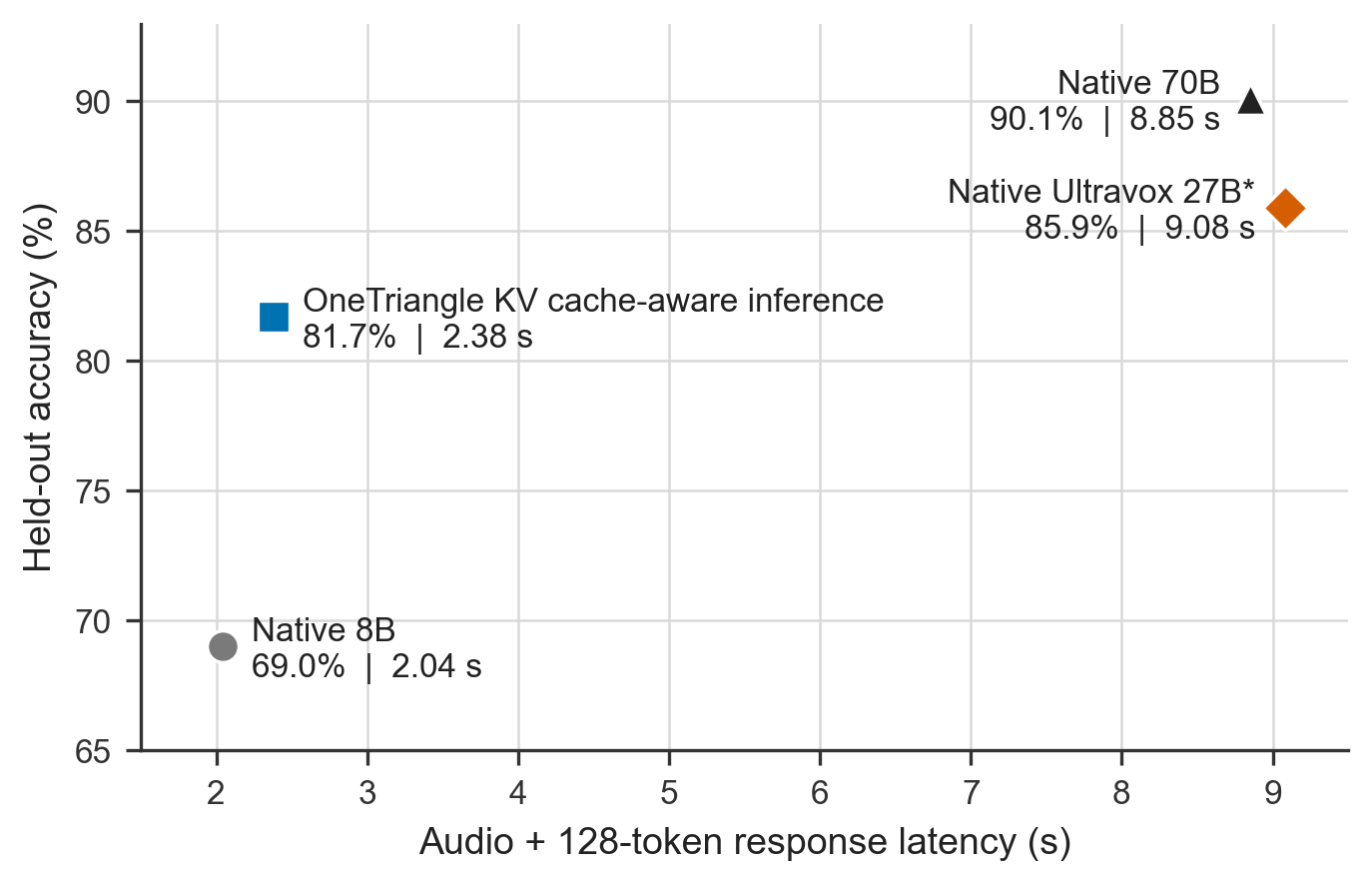
The result
A useful point between the small and large models.
Native 8B is fast, but it answered 69.0% of the held-out audio questions correctly. Native 70B reached 90.1%, but generated at only 14.63 tokens per second.
Our OneTriangle KV cache-aware inference path reached 81.7% accuracy and 59.64 tokens per second. It recovered much of the quality gap while retaining 93.5% of native-8B decode throughput.
- Native 8B
- 69.0% accuracy · 63.82 tokens/s · 2.04s response
- OneTriangle KV cache-aware inference
- 81.7% accuracy · 59.64 tokens/s · 2.38s response
- Native 70B
- 90.1% accuracy · 14.63 tokens/s · 8.85s response
Try it locally
Listen to verified examples or ask your own question.
The first tab replays real held-out examples. The second tab connects to the localhost-only two-H100 comparison bridge.
Audio comparison
Send one spoken question through all three paths.
Water levels may decrease on cloudless days because…
- A. water is warmer than the air
- B. air is warmer than water
- C. moisture is pulled upwards
- D. moisture always tries to rise
Native 8B
Small model
OneTriangle KV cache-aware inference
70B read → 8B answer
Native 70B
Large model
These nine examples are selected from the untouched final set because the three methods answered differently. The sealed 71-example totals are reported below.
How it works
Use the large model once. Use the small model for every new token.
- 01Listen with 70B.
Ultravox 70B turns the spoken prompt into a rich KV cache.
- 02Translate the cache.
A quantization-aware mapper converts selected 70B layers into the 8B cache format.
- 03Answer with 8B.
The frozen 8B model generates from that cache at close to its native speed.
The mapper runs once at the handoff. It does not run again for each generated token.
Latency
Most first-token time is spent in 70B audio prefill.
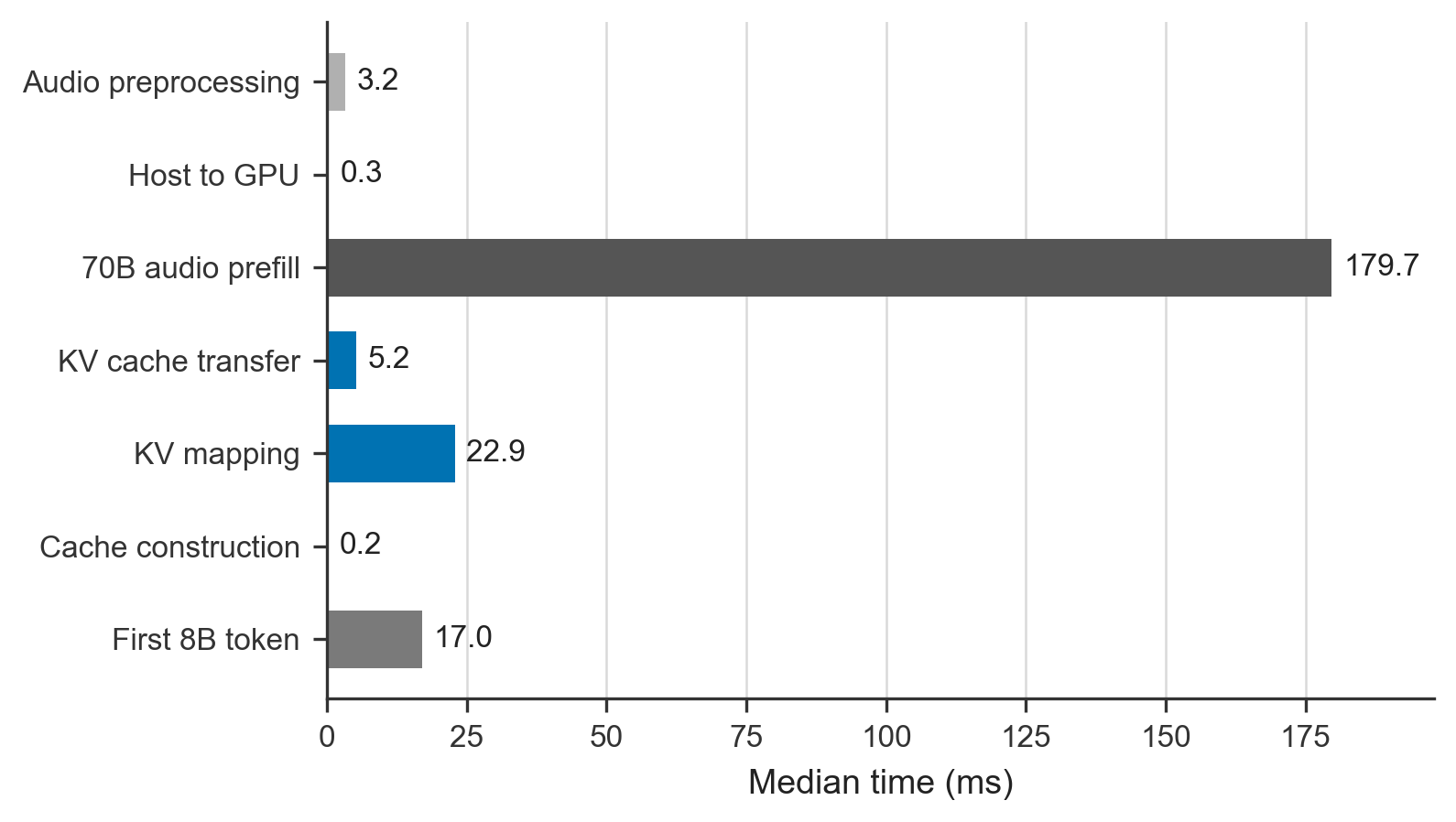
Cache transfer and mapping take 28.1 milliseconds together. The 70B audio prefill takes 179.7 milliseconds.
Cost
OneTriangle KV cache-aware inference costs 73% less than native 70B.
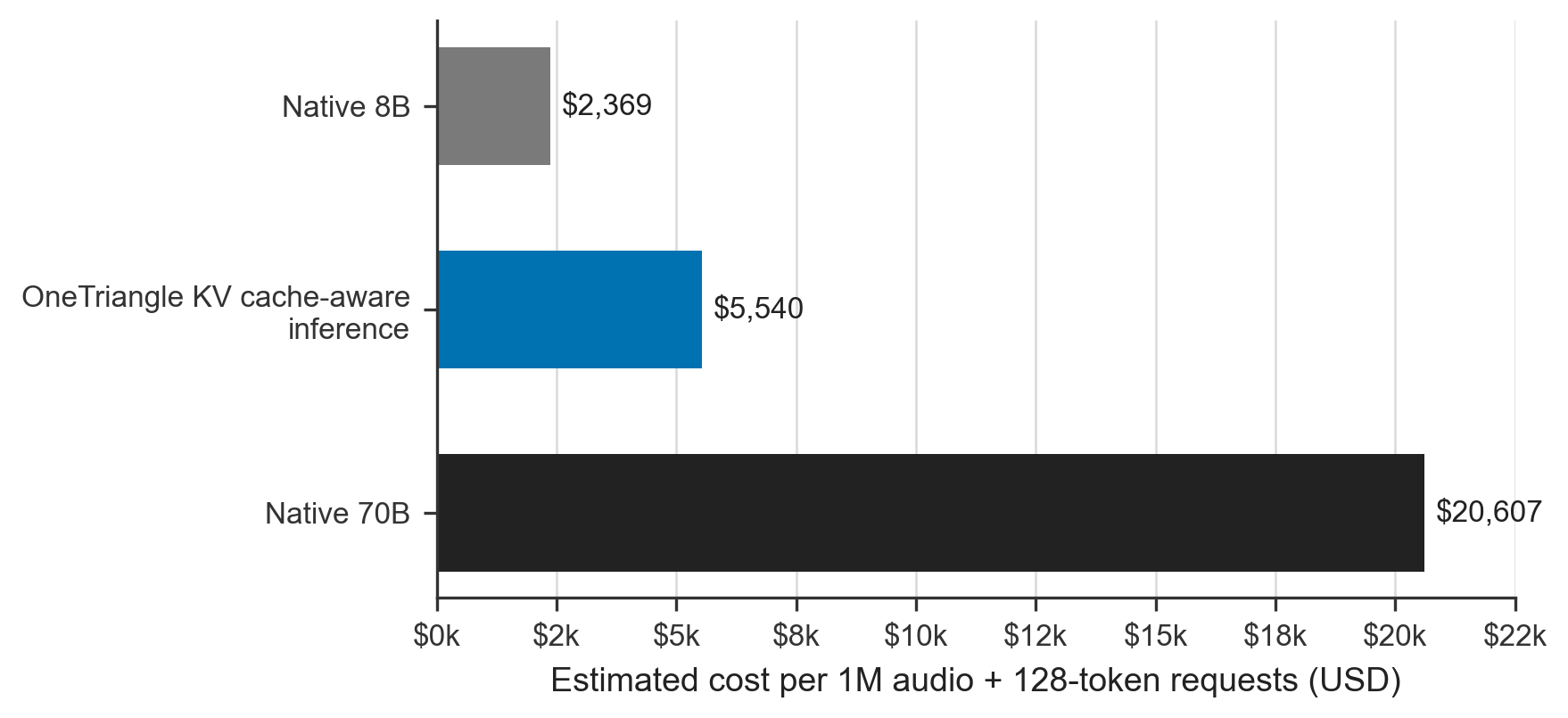
The measured busy-time estimate is $5,540 per million audio plus 128-token responses. That is about 73% below native 70B. The estimate uses $4.19 per H100-hour and excludes loading, idle capacity, storage, and networking.
Future applications
Better voice systems without full-size generation.
- Voice agents: stronger answers with near-8B generation speed.
- Customer support: better understanding of spoken questions before a long response.
- Audio search: richer interpretation of retrieved or transcribed evidence.
- Adaptive routing: use native 8B for simple requests and OneTriangle KV cache-aware inference when quality matters more.
- Shared context: reuse an enriched prefix across a conversation or a batch of related requests.
Next experiments
Make the large-model read cheaper and easier to reuse.
- Cache and reuse shared audio or system-prefix representations.
- Overlap source prefill, mapping, and target setup.
- Test sparse and smaller teacher models for a faster first token.
- Train on broader conversational audio, not only multiple-choice tasks.
- Evaluate the live bridge under concurrent requests and longer conversations.
Measured scope: quality used 71 untouched VoiceBench OpenBookQA examples. Latency used one fixed sample, one warmup, five runs, and 128 generated tokens on two H100 80GB GPUs. Model loading was excluded.