
What k means
Each target layer gets to look at k source layers.
A KV-cache mapper has to predict every target layer's keys and values from the source model. For each target layer, we score every source layer, choose the top k, concatenate their cache features, and fit a per-head ridge map.
A larger k gives the mapper more views of the source representation. It also widens the solve and increases mapping work, creating a measurable tradeoff among fit, behavior, and cost.
The sweep
We tested the curve instead of blessing one width.
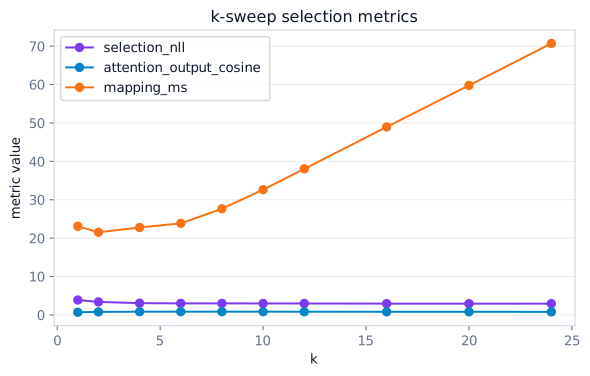
The paper-scale run fit k ∈ {1, 2, 4, 6, 8, 10, 12, 16, 20, 24} on 500 FineWeb-Edu prompts and compared them on 100 disjoint selection prompts. The frozen selector chose the lowest mean prefix negative log-likelihood, then used attention-output cosine and mapping time only as tie-breakers.
Three different winners
Each objective highlights a different best setting.
Prefix loss kept improving at the wide end. It fell from 3.002 at k=8 to 2.930 at k=24, a 2.4% reduction. Under the frozen rule, that made k=24 the winner.
Attention-output cosine peaked earlier. It reached 0.849 at k=8, then fell to 0.797 at k=24. Mean mapping time moved the other way, climbing from 27.7 ms to 70.7 ms.
The selected k=24 mapper later paired 91.2% normalized benchmark retention with 65% next-token agreement. That result motivates a behavior-aware replay across all widths, where fidelity can select the best candidate and reconstruction loss can remain a supporting signal.
What we changed
Select on behavior, then ask about speed.
Our next replay gives every k the same fresh, disjoint prompts and compares multistep token divergence before touching the final evaluation set. The primary selector becomes behavioral fidelity, with attention similarity, perplexity, and mapping cost as supporting signals.
If a smaller k preserves behavior, we get a simpler mapper with lower mapping cost. Comparing the divergence pattern across every width will also show whether to focus next on source-layer count, partial target recompute, richer maps, or another model pair.
This sweep covers one real Qwen3 model pair under one fit and selection protocol. The next replay tests how well the tradeoff generalizes and reselects on the behavior we intend to ship.