
The result
The quality stayed. The wait got shorter.
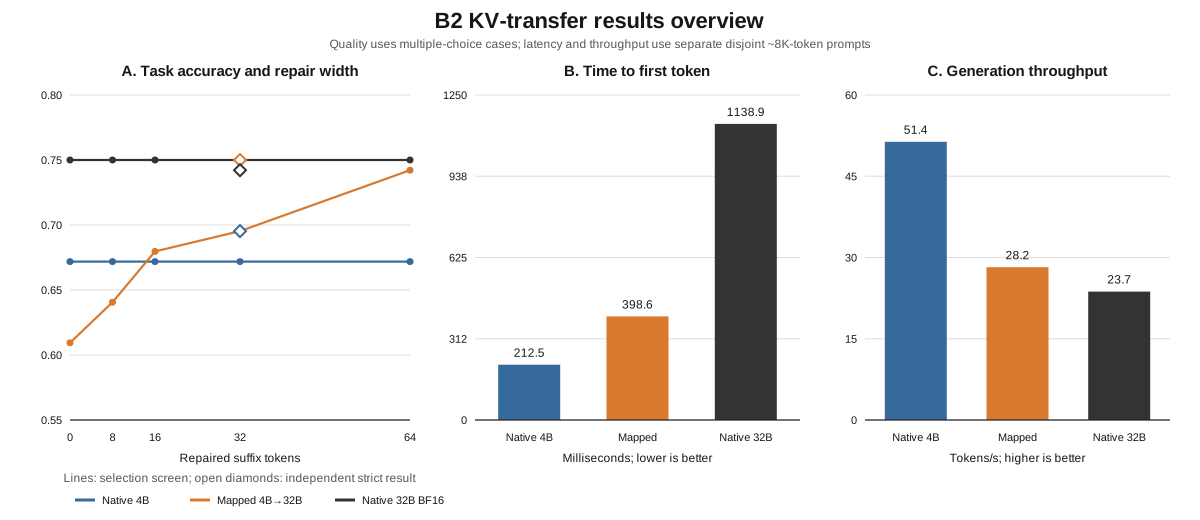
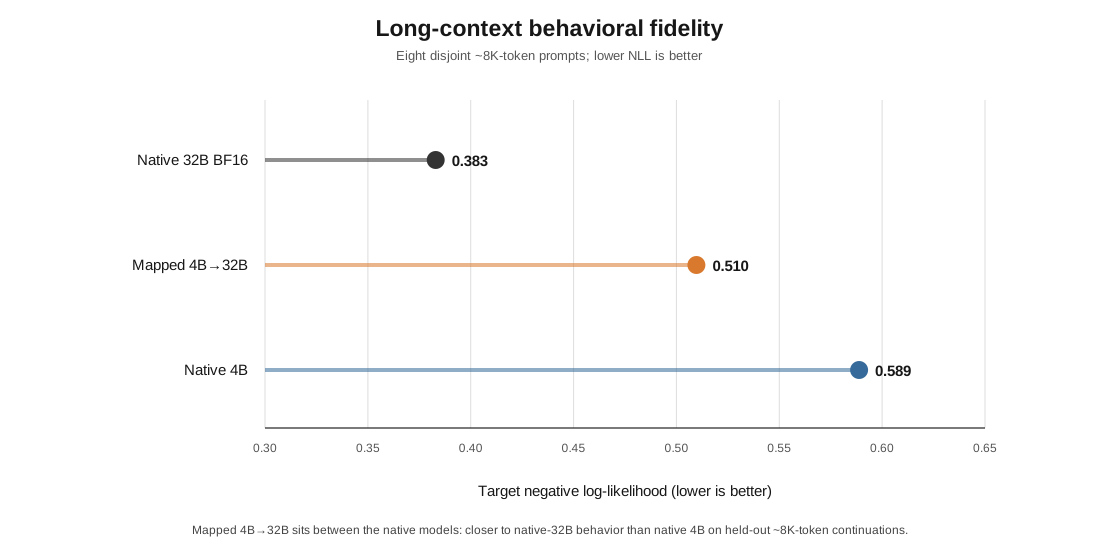
On a strict, disjoint 128-case multiple-choice set, mapped 4B→32B inference scored 96/128. Native Qwen3-4B scored 89/128 and native Qwen3-32B scored 95/128. On eight long-context prompts, the mapped system delivered 28.21 tokens/s against 23.70 for native 32B, while total latency fell from 10.80 to 9.08 seconds.
The method
Prefill small. Repair locally. Decode large.
Qwen3-4B reads the long prompt on the first H100. We transfer its key-value cache to Qwen3-32B on the second H100 by matching layers at the nearest normalized depth. This direct path uses no learned mapping coefficients.
The 32B model then recomputes only the latest 32 prompt tokens. That short causal repair restores the recent context most relevant to the next prediction without paying for a full 32B prefill. During generation, an adaptive speculative schedule proposes blocks between 4 and 24 tokens, handles mismatches early, and commits a bonus token when the verified block permits it.
- 01
Draft prefill
Qwen3-4B builds the prompt KV cache on GPU 0.
Fast small-model TTFT - 02
Direct mapping
Map 36 layers to 64 at the nearest normalized depth.
No learned weights - 03
Target repair
Qwen3-32B recomputes the latest 32 prompt tokens on GPU 1.
Recover task quality - 04
Speculate
Adaptive 4→24-token blocks use fast mismatch handling and bonus commits.
84.1% mapped agreement
Quality retention
Thirty-two repaired tokens reached the balanced frontier.
Without repair, mapped accuracy was 78/128. Repairing 8, 16, 32, and 64 recent tokens raised it monotonically to 82, 87, 89, and 95 correct answers. The strict follow-up for the selected 32-token policy reached 96/128, one answer above the native 32B control on that sample.
Latency and throughput
The first token arrived 2.64× sooner.
Against native 32B BF16 inference, mapped 4B→32B cut median time to first token from 1,139 ms to 399 ms, a 62.1% reduction. End-to-end latency improved by 15.1%, with a paired speed ratio of 1.177× and a 95% interval from 1.045× to 1.325×. Throughput increased from 23.70 to 28.21 generated tokens/s.
Native 4B remained faster at 51.37 tokens/s. The point of this operating mode is not to beat the small model's raw speed. It is to retain large-model-level task behavior while avoiding much of the large model's long-context prefill cost.
What this proves
A useful frontier point, not exact 32B inference.
The mapped verifier accepted 84.1% of proposals. This is agreement with the transferred-cache verifier and is the mechanism that raises generation throughput.
This experiment establishes an audited speed-quality operating point for KV-transfer inference: native-32B-level accuracy on one strict task set, faster long-context response, and reproducible two-H100 execution.