
The handoff
Could 1.7B read the prompt for 4B?
Long prompts are expensive because every model asked to continue them has to build its own attention cache. We wanted to know whether Qwen3 1.7B could do that first pass, translate its keys and values, and let Qwen3 4B start decoding from the translated state.
Shape compatibility is the starting point. Our acceptance protocol then checks implementation controls, held-out task accuracy, token distribution fidelity, and latency in that order to verify that the target model preserves its intended behavior.
What we ran
One real model pair with disjoint fit, selection, and evaluation data.
- Source model
- Qwen3 1.7B
- Target model
- Qwen3 4B
- Mapper fit
- 500 FineWeb-Edu prompts
- Selection
- 100 disjoint prompts
- Token fidelity
- 100 WikiText prefixes
- Task checks
- 1,000 HellaSwag + 1,000 PIQA
- Source-layer count
- k=24 selected from 10 candidates
- Runtime
- BF16 model, FP32 solve, H100
For each target layer, the mapper selected source layers, removed source rotary position encoding from keys, learned per-head linear maps in content space, then applied target positions before cache injection. Target-cache reinjection and negative controls passed before we trusted the mapped result.
What improved
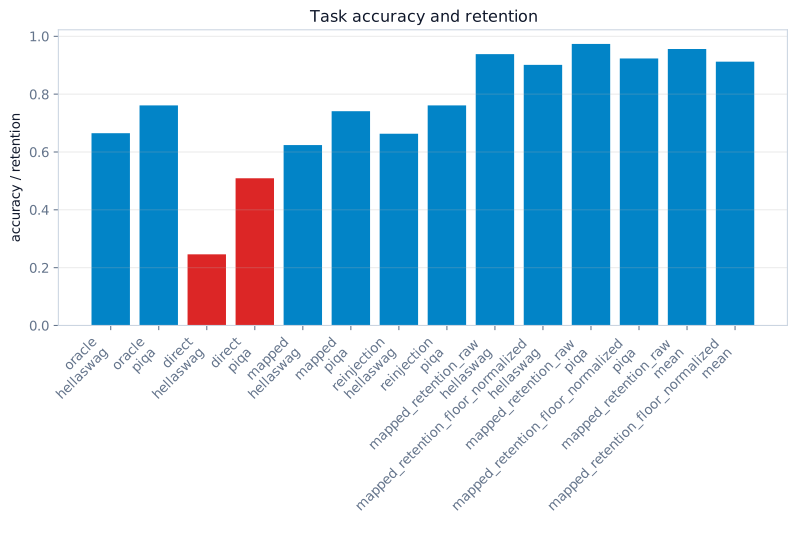
The map retained 91.2% of normalized task quality.
On HellaSwag, the mapped cache scored 62.4% against the target oracle's 66.5%. On PIQA it scored 74.1% against 76.1%. After accounting for each task's chance floor, mean retention was 91.2%, above our 80% gate.
The learned map lifted HellaSwag accuracy to 62.4% from 24.6% with direct injection, a 2.5× improvement. PIQA rose to 74.1% from 50.9%. Together, those gains show that the map recovered useful structure beyond compatible tensor dimensions.
The fidelity signal
65% agreement defines the next optimization target.
The mapped cache matched a normal Qwen3 4B prefill on the next token 65% of the time. A 2,000-resample bootstrap placed the 95% confidence interval at 56% to 74%. Our next milestone is to move that distribution to the predeclared 80% fidelity threshold.
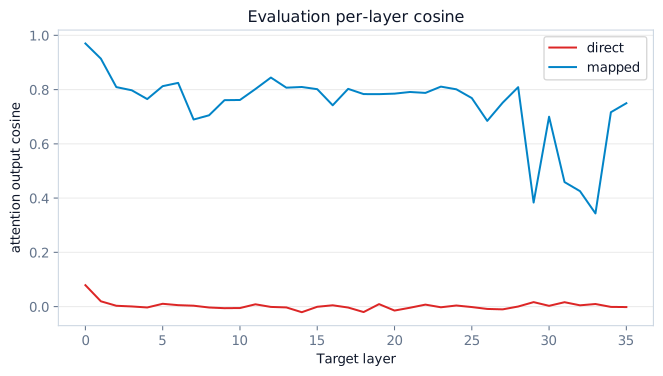
The mapped-to-oracle perplexity ratio reached 1.238, inside the 1.25 limit, while mean mapped attention-output cosine reached 0.743. These diagnostics help locate which representations to improve in the next replay.
A legacy rollout heuristic labeled mapped and normal oracle text alike, so the next replay will use corrected rollout metrics. That gives the follow-up study a cleaner measure of multistep behavior.
Next experiments
Locate the remaining token divergence, then measure speed.
First, we will replay multiple mapper depths on fresh, disjoint prompts and compare multistep token agreement. This tests whether additional source context or a narrower map best preserves the target model's behavior.
Next, causal interventions will replace mapped keys, values, or selected target layers with oracle state. That experiment can show where the remaining divergence concentrates and whether partial target recompute is enough. Once fidelity reaches the target range, a synchronized latency study will measure the savings against ordinary 4B prefill.